
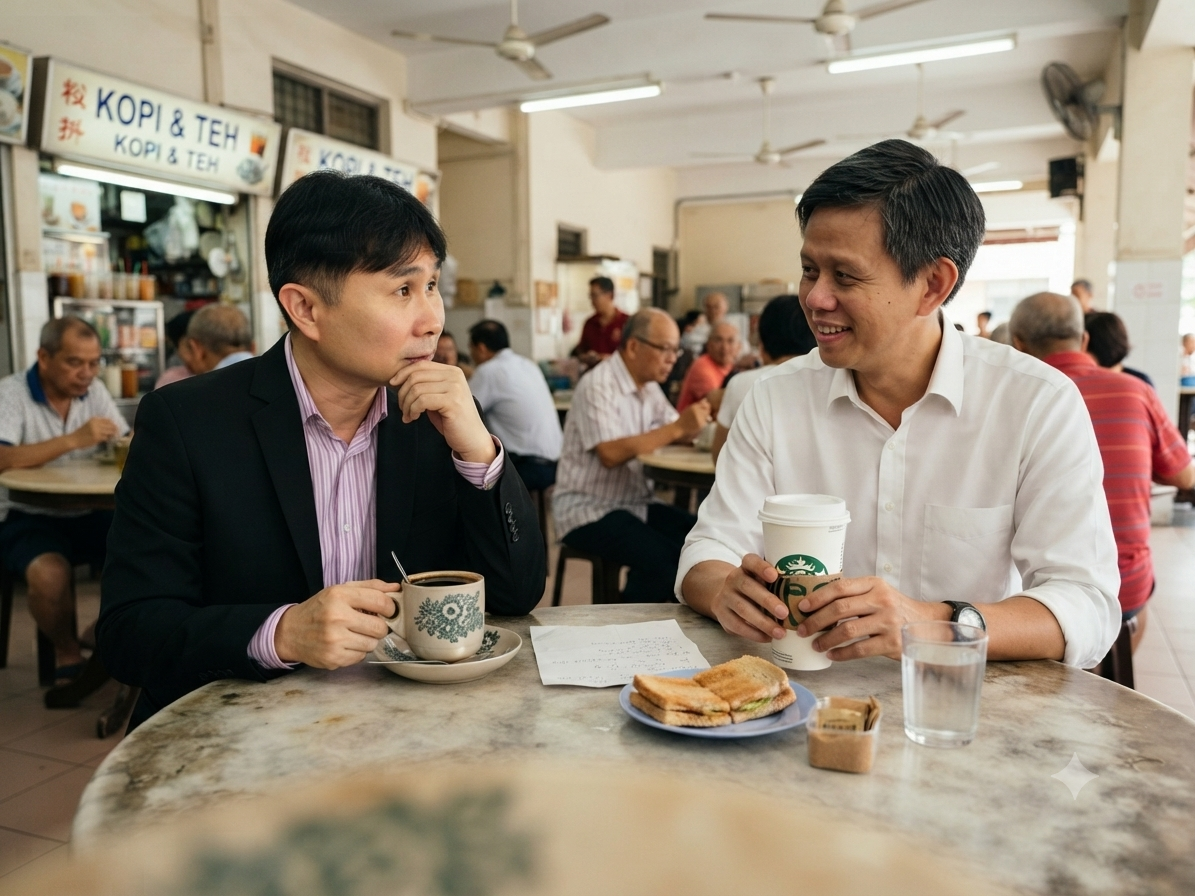
Eh kakis, pull up a plastic chair, grab a tissue to chope your seat, and let me break down the latest Parliament saga that has everyone from aunties at the wet market to keyboard warriors on EDMW scratching their heads.
Picture this: while the rest of us are stressing over whether $1.80 is too much to pay for a cup of kopi-O, our politicians are out here playing high-stakes Math Olympiad with millions of dollars.
The core of the drama? A good old-fashioned numbers clash between the ruling party and the Workers’ Party over how much an entry-level minister (fancy-named the “MR4” grade) should actually take home.
The $1.8 Million Brew vs. The $1.08 Million Formula
Here is how the tea (or kopi) is being spilled. The government’s official benchmark for an entry-level minister sits at an eye-watering $1.8 million a year.
How do they get this number? They take the median annual income of Singapore’s top 1,000 earners—yes, the absolute ultra-rich corporate high-flyers—and slap a 40% discount on it, as if they’re having a Black Friday sale on governance.
Enter Professor Jamus Lim, the Workers’ Party’s resident economics wizard. While on a trip to Taiwan with residents (and listening in from afar like a hardworking student tuning into Zoom class while on holiday), Jamus decided to drop a Facebook homework assignment challenging the government’s math.
According to Jamus, if you use the WP’s proposed formula, an entry-level minister’s pay today would actually be around $1.08 million. Still not small change by any standard, but a long way off from $1.8 million.
The “Double-Counting” Blur Sotong Moment
Why the massive gap? Jamus reverse-engineered older civil service numbers—specifically looking at the MX9 grade, which sounds like a secret government transformer robot but is actually the starting tier for senior management in the civil service.
Back in 2022, then-Minister-in-charge of the Public Service Chan Chun Sing revealed that annual pay for an MX9 ranged from $200,000 to $260,000, including a 20% to 35% variable bonus component. When the government calculated the current yield of the Workers’ Party formula, Jamus suggested their numbers were somewhat off the mark.
He claimed the government treated the total salary as a fixed base before stacking the bonus on top, effectively counting the bonus twice. “Wah, like that my secondary school math teacher will faint you know,” Jamus essentially argued, accusing the ruling party of doing calculations like an ah pek trying to figure out his 4D winnings after three bottles of Tiger beer at a coffeeshop zi char session. He pointed out that the government’s own recent initial one-off pay bumps for political officeholders actually looked a lot closer to what the WP formula would imply anyway.
Atas CBD Latte vs. Void Deck Kopitiam Philosophy
At the end of the day, Jamus stressed that this isn’t just about crunching numbers or arguing over whether a million dollars is loose change. It’s a fundamental clash of philosophies on what public service is actually supposed to feel like.
- The Government’s View: You need to peg political salaries to the top corporate earners to attract top-tier talent and prevent brain drain to the private sector.
In other words: If you want CEO-level brainpower to run the island, you better pay CEO-level money.
- The Workers’ Party’s View: Political pay should be pegged to top civil servants (like our MX9 robot-tier friends).
Their argument is simple: political leadership is a public service duty, not a corporate bidding war.
You anchor it to the public sector they lead, not the private towkays making millions in the CBD.
So, where does that leave us? Basically, it’s a classic Singaporean standoff.
The government is sitting pretty in an air-conditioned boardroom sipping a $10 artisanal oat-milk matcha latte from MBS, while the opposition is holding firm at the void deck kopitiam, banging their porcelain cups and shouting: “Eh, standard $1.30 kopi-O peng already very good liao, don’t need to benchmark to the moon to run the engine properly!”
Now, drink your kopi before it gets cold. What’s your take—are our ministers worth the $1.8m corporate price tag, or should we keep it grounded at the kopitiam?

 Kopi Kaki SG
Leave a comment