
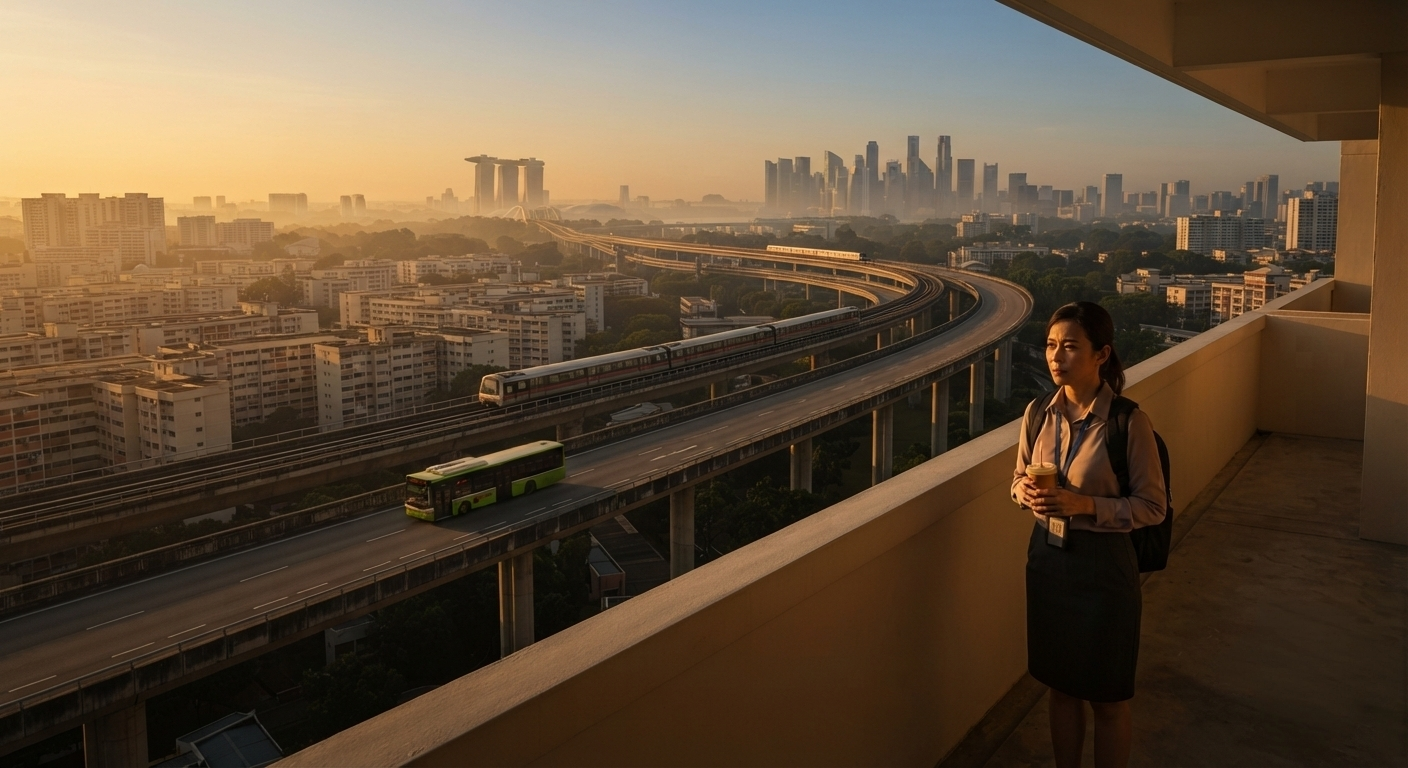
Pour yourself a thick cup of kopi-peng, pull up a wobbly plastic kopitiam stool, and let’s talk about Singapore’s ultimate badge of endurance: the daily pilgrimage from Sembawang.
According to the Department of Statistics’ General Household Survey, Sembawang residents have officially snagged the heavyweight championship title for the longest median work commute in Singapore, clocking in at a cool 50 minutes.
Of course, anyone who has actually lived through the heartland gauntlet knows that “median survey time” is polite statistical code for: “By the time you reach your office desk, you’ve mentally aged three decades, written a trilogy, and started questioning every major life choice that led you to the northern frontier.”
Welcome to Narnia: Where the CBD Feels Like a Myth
Compare this to the lucky folks living in Tanglin, who enjoy a breezy 25-minute zip to work, and you realize that living in Sembawang is basically like buying a timeshare in Narnia.
Sure, it’s peaceful, leafy, and you can practically wave hello to the rooftop cafes of Johor Bahru if you lean out your window hard enough—but trying to get to a CBD office requires the emotional resilience of a zen monk and the physical agility of a circus contortionist.
Phase 1: The Feeder Bus Bermuda Triangle
The nightmare doesn’t even begin at the MRT station; it starts right at the void deck bus stop. Sembawang’s feeder buses operate on a mystical, physics-defying phenomenon known as the Clumping Matrix.
You arrive at the bus stop, check your app, and watch in despair as zero buses materialize for twenty agonizing minutes, giving you plenty of time to contemplate adopting a stray cat or learning how to unicycle.
Then, true to form, chaos strikes: three identical buses show up at the exact same time like a synchronized triple-tsunami of public transport. Boarding one requires the fierce, unyielding competitive spirit of a bargain hunter fighting for discounted sashimi at Don Don Donki just before closing time.
Phase 2: The Multi-Transit Marathon
For those whose commutes involve chaining buses, the North-South Line (NSL), and cross-island MRT transfers (like battling your way from Sembawang all the way across to Jurong East or the East), the travel time balloons past an hour easily.
As some resilient residents have pointed out, combining buses and rail lines can easily push total travel times past the 50-to-56-minute statistical ceiling once you factor in waiting times, missed connections, and the emotional baggage of playing human Tetris during morning peak hours. You stare blankly at fellow commuters who look like extras from The Walking Dead, all silently bonding over the shared trauma of living past Yishun.
Is There Hope at the End of the Line?
Authorities point to the Thomson-East Coast Line (TEL) and various bus enhancements under schemes like the Bus Connectivity Enhancement Programme to throw northern residents a lifeline.
MPs and planners note that many can catch the train or hop on express routes. But until teleportation is successfully commercialized at the local void deck, Sembawang residents remain the undisputed unsung heroes of the Singaporean workforce.
They don’t just “go to work”—they launch expeditions. So the next time you complain about your five-stop train ride, take a sip of your kopi, pour one out for our northern homies, and give thanks that you don’t have to hunt for Bus 859 in the dark.

 Kopi Kaki SG
Leave a comment